Quick answer: Building plan approval is the official permission from your local municipal corporation or development authority that you must obtain before starting construction in India. The process involves preparing architect-certified drawings, submitting through your city's specific online portal, passing scrutiny and a site inspection, and paying the applicable fee — typically taking 15 to 45 days in major metros with complete documentation, and 30 to 90 days in smaller cities. Constructing without this approval is illegal and can lead to penalties, a stop-work order, or demolition.
Every year, thousands of homeowners across India start construction with a hand-drawn plan and a verbal go-ahead from a mason, only to receive a municipal notice months later — work stopped, a fine issued, and a portion of the structure ordered to be demolished for violating setback or height rules. The approval itself almost always costs far less than fixing a violation after the fact.
This guide walks through exactly what building plan approval involves, which portal or authority applies in major Indian cities, the real timeline to expect, and where most homeowners lose weeks they didn't need to.
→ Already have your drawings ready? Find a verified architect to help you submit and track your approval at bidandbuild.in.
Have a City-Specific Guide? Start There
If your city has a dedicated guide, it will save you more time than this national overview — it covers the exact portal, fee slabs, and local rejection reasons:
- Building Plan Approval in Bhopal 2026 — ABPAS 3.0
- Building Plan Approval in Indore 2026
- Building Plan Approval in Jaipur 2026 — JDA/BPAS
- Building Plan Approval in Patna 2026 — PMC AutoMap
- Building Plan Approval in Lucknow 2026 — LDA FastPass
For any other city, the process below and the authority table apply — confirm the exact current portal with your local office before submitting.
What Is Building Plan Approval, and Why It's Mandatory
Building plan approval — also called building plan sanction or a building permit — is formal permission from your local authority to construct, renovate, or demolish a structure on your plot. The authority responsible varies by location:
- A municipal corporation in most cities
- A development authority, such as DDA in Delhi or HMDA in Hyderabad, for areas under a wider master plan
- A gram panchayat in rural areas
The approval confirms your proposed construction follows the National Building Code 2016 and your state's specific bye-laws, covering setbacks, Floor Area Ratio (FAR), height limits, parking requirements, and zoning rules. Constructing without this sanction is treated as unauthorized construction under municipal law in most states, and the consequences are not theoretical:
- Sealed construction sites
- Withheld utility connections
- Denial of an Occupancy Certificate
- Complications at resale
Which Authority and Portal Applies in Your City
India runs no single national approval system — every state and major city operates its own portal, with its own document templates and timelines. Knowing your specific system before you start saves real weeks.
| City | Authority | Online System |
|---|---|---|
| Bengaluru | BBMP / BDA | BBMP e-Governance Portal |
| Mumbai | MCGM | Auto-DCR online system |
| Delhi | DDA / MCD / NDMC | MCD Unified Building Plan Portal · DDA Building Section |
| Hyderabad | HMDA / GHMC | TG-bPASS (21-day auto-approval for plots under 500 sq.m.) |
| Chennai | CMDA / GCC | TN Online Building Plan Approval — confirm current portal with CMDA/GCC directly |
| Pune | PMC | PMC Online Building Permission — confirm current portal with PMC directly |
| Patna | PMC / Patna Regional Development Authority | AutoMap Portal |
| Jaipur | JDA (Jaipur Development Authority) | BPAS — Rajasthan Single Window Clearance System |
| Bhopal | Bhopal Municipal Corporation (BMCWS) | ABPAS 3.0 |
| Indore | Indore Municipal Corporation (IDMC) | Madhya Pradesh eNagarPalika portal — confirm current link with IDMC directly |
| Lucknow | Lucknow Development Authority (LDA) | UP-wide BPAS / OBPAS (also covers KDA, GDA, ADA) |
| Nagpur | Nagpur Municipal Corporation (NMC) | MahaVastu / Building Plan Management System |
| Ahmedabad | AMC (city limits) / AUDA (peripherals) | Ahmedabad's own Building Plan Approval System (BPAS) — confirm current portal with AMC/AUDA directly |
| Surat | Surat Municipal Corporation (SMC) | Auto DPA (Development Permission Application software) — confirm current portal with SMC directly |
| Coimbatore | Coimbatore City Municipal Corporation (CCMC) | CCMC Online Plan Approval |
| Visakhapatnam | GVMC, under VMRDA jurisdiction | GVMC Building Plan Approval Online — confirm current portal with GVMC directly |
| Kanpur | Kanpur Development Authority (KDA) | UP-wide BPAS / OBPAS (also covers LDA, GDA, ADA) |
A few patterns worth knowing before you assume your city needs a separate system:
- Hyderabad's TS-bPASS and Visakhapatnam's reformed GVMC system are currently the two fastest-improving approval processes in the country — Visakhapatnam's first-week approval rate jumped from 20% to 71% after a 2026 reform, a sharper improvement than most other major cities have managed in the same period
- Most other major cities still run a manual technical scrutiny process even when submission itself happens online
- Madhya Pradesh runs both Bhopal and Indore through the same statewide eNagarPalika system, rather than separate city portals — Bhopal has since moved to the newer ABPAS 3.0 layer on top of it
- Maharashtra does the same for Nagpur and other cities through MahaVastu
- Gujarat runs Ahmedabad and Surat through two genuinely different systems despite being in the same state — Ahmedabad's own BPAS versus Surat's Auto DPA — which shows that even within one state, assuming a neighboring city's system applies to you can be a real mistake
- Online systems can change without much public notice — Uttar Pradesh homeowners discovered this when new submissions on the state's OBPAS portal were suspended by government order in mid-2026, a disruption that affects both Lucknow and Kanpur applicants directly
Always confirm the current submission method with your local authority before relying on any single named portal, including the ones listed here.
In my own experience reviewing approval drawings for residential projects, the single biggest predictor of a fast approval isn't the city or the portal — it's whether the architect has actually submitted to that specific authority before. The bylaw knowledge that prevents rejections rarely comes from a manual; it comes from having seen what that particular office flags.
If you're planning to build in Patna specifically, our guide on house construction costs in Patna covers locality-level context that pairs well with this approval process, and our Top 10 Architects in Patna guide — including Ar. Abhishek Kumar, Studio Coherent — can help you find someone who already knows the local approval system firsthand. For Indore specifically, our guide on Best Architects in Indore covers professionals who already navigate IDMC's process regularly. For Bhopal, see Building Plan Approval in Bhopal — ABPAS 3.0 for the current portal and fee breakdown, reviewed by Ar. Divyansh Soni, Studio Brhma. For Jaipur, our Best Architects in Jaipur guide includes Ar. Satyam Kumawat, who regularly files through JDA's BPAS system.
The 7-Step Building Plan Approval Process
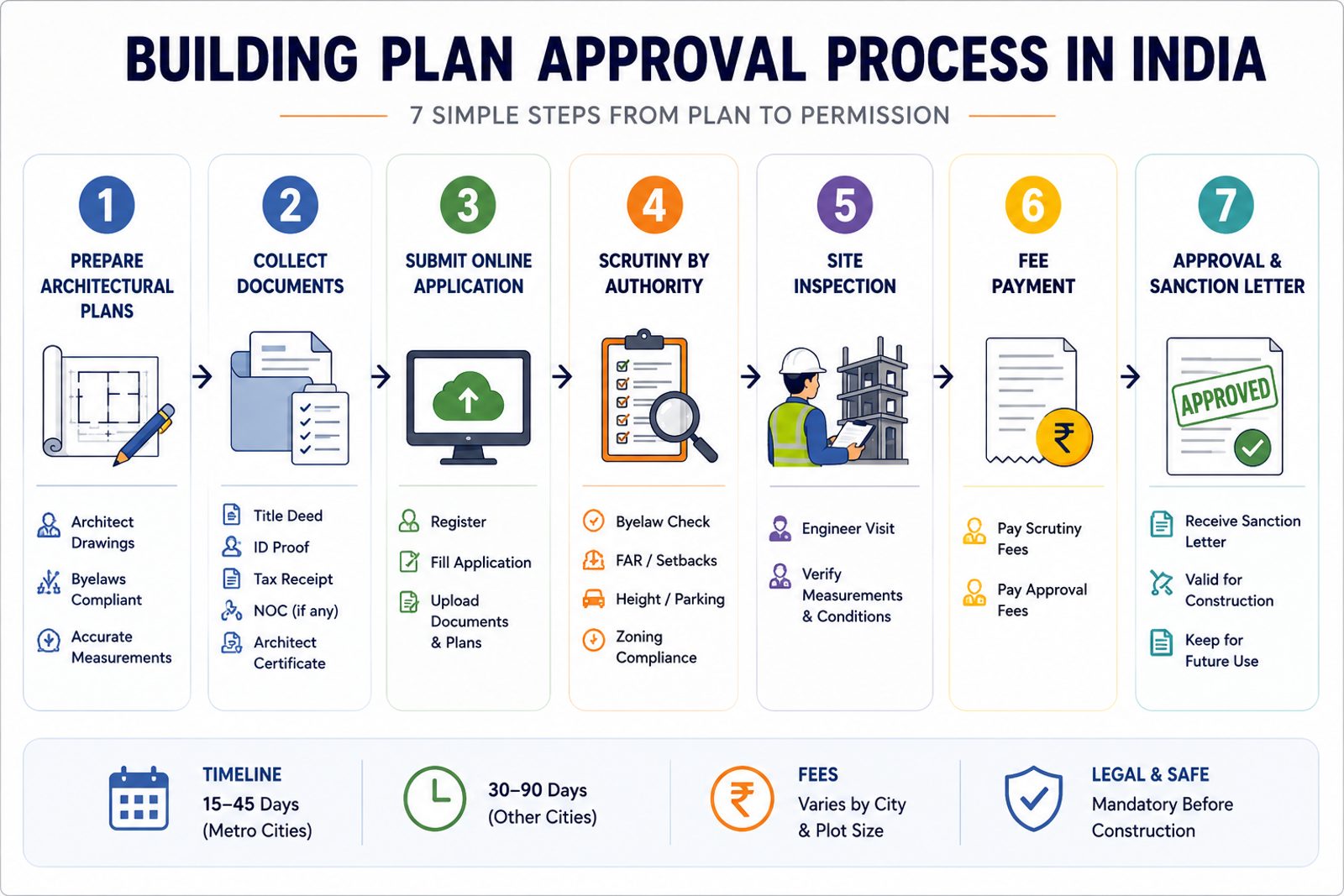
1. Confirm Your Land Use and Zoning
Before anything else, confirm your plot is zoned for the construction you intend — residential, commercial, or mixed-use. If your land is currently classified as agricultural, you'll need Non-Agricultural (NA) conversion approval first, since no other permission will be granted on agricultural land.
2. Hire a Licensed Architect or Structural Engineer
Your building plan must be prepared and signed by a licensed architect or structural engineer registered with the Council of Architecture or equivalent body. In most cities, including Bengaluru and Hyderabad, you cannot even submit the application as the property owner — the architect or engineer must be the registered submitter on the portal.
3. Prepare the Required Drawings and Documents
Your architect will prepare:
- Floor plans for each level
- Elevations and sections showing height and setbacks
- Area statements with FAR calculations
- Structural drawings
- A soil investigation report and structural stability certificate, for multi-storey buildings
Alongside the drawings, you'll need:
- Land ownership proof, such as a registered sale deed or khata certificate
- An Encumbrance Certificate covering the last 15 to 30 years
- Your latest property tax receipt
- Identity proof
- Neighbour Consent Letter — required in Delhi and Mumbai when the proposed building encroaches within 3 metres of the plot boundary
Documents vary by state, so confirming the exact checklist with your local authority before submission saves a real round-trip delay.
4. Submit Your Application
Register and submit through your city's specific portal — BBMP's e-Governance system in Bengaluru, Auto-DCR in Mumbai, or the equivalent in your city — uploading drawings and documents and paying the scrutiny fee to receive an acknowledgement and tracking ID. In smaller towns and rural areas, submission may still happen physically at the local office.
5. Scrutiny and Site Inspection
The authority reviews whether your drawings comply with FAR, setback, coverage, height, and parking norms, and checks that your documents are consistent with land records. A site inspection typically follows, verifying plot boundaries, road access width, and any existing structures — any mismatch between the site and your submitted plan can trigger queries or objections that add weeks to your timeline.
6. Obtain Applicable NOCs
Depending on your project and location, you may need No Objection Certificates from:
| NOC | Typically Required For | Usual Time |
|---|---|---|
| Fire department | Height above 15–18m or high-occupancy buildings | 2–4 weeks |
| Pollution Control Board | Larger residential/commercial projects | 3–6 weeks |
| Airport Authority (AAI) | Plots near airport funnel/height zones | 3–6 weeks |
| Water & electricity utility | Most new connections | 2–4 weeks |
These NOCs often take 2 to 6 weeks on their own, so applying for all applicable ones in parallel with your drawing preparation, rather than waiting for the municipal body to ask, is one of the simplest ways to save real time.
7. Pay Fees and Receive Sanction
Once scrutiny and inspection are cleared, you pay the approval fee, which depends on your built-up area and building type, and receive your sanctioned plan along with a Commencement Certificate. This certificate confirms you can legally begin construction, and in many cities a partial certificate may be issued stage by stage as larger projects progress.
How Long Does Building Plan Approval Actually Take?
| Project Type | Typical Timeline |
|---|---|
| Residential, major metro, complete documents | 15–45 days |
| Residential, smaller city | 30–90 days |
| Residential with NOCs required | 60–120 days |
| Commercial / multi-storey | 6–12 weeks minimum, often longer |
Each revision cycle requested by the authority typically adds 2 to 4 weeks on its own, which makes complete, correctly formatted documentation the single biggest factor in staying at the lower end of these ranges. The plinth-level check after sanction is also worth planning around — even a small setback discrepancy discovered at this stage can trigger a stop-work notice until it's resolved.
5 Common Mistakes That Delay Building Plan Approval
- Designing first and checking bylaws afterward, rather than starting with setback, FAR, and height limits as fixed constraints — this is one of the most common reasons a completed design has to be substantially reworked.
- Submitting drawings that don't follow your local authority's specific template format — every city's portal has its own required drawing format, and a generic drawing rarely passes scrutiny on the first attempt.
- Inconsistent documents, such as a name spelled differently across the sale deed and tax receipt, or an outdated Encumbrance Certificate — these get flagged immediately during document verification and require a fresh resubmission.
- Waiting until the municipal body asks for NOCs, rather than applying for fire, water, or pollution clearances in parallel with drawing preparation — this routinely adds weeks that didn't need to happen.
- Starting construction before receiving formal sanction, assuming approval is a formality once submitted — this is how homeowners end up with stop-work notices and costly demolition of already-built portions.
Do You Need an Architect for Building Plan Approval?
Yes, in nearly every state, your building plan must be signed by a licensed architect or structural engineer to be accepted at all — and in several cities, including Bengaluru, you cannot submit the application yourself even with a complete plan in hand. Beyond the legal requirement, an architect who regularly works with your specific local authority knows the unwritten practical details — exact drawing formats, common objection points, which NOCs apply to your zone — that a first-time applicant has no way of anticipating.
For a complete walkthrough of how to evaluate and hire the right architect for your project, read how to hire an architect, contractor, or interior designer in India.
→ Compare verified architects in your city who can prepare and submit your building plan at bidandbuild.in.
What Happens If You Build Without Approval?
Unauthorized construction can be sealed or ordered demolished by the municipal authority, and the financial loss in such cases is almost always far higher than the approval fee would ever have been. Beyond demolition risk, properties without sanctioned plans typically cannot get:
- A water connection
- An electricity meter
- An Occupancy Certificate
This makes the property difficult to sell, mortgage, or insure later. Banks also generally refuse a construction loan or home loan top-up without seeing an approved plan first, which means skipping this step can stall financing just as much as it risks legal trouble.
Once construction is properly approved and budgeted, our guide on how to build a house in India walks through what comes next, from foundation to move-in.
The Legal Backbone: Model Building Bye-Laws 2016 and Deemed Approval
Most of India's building approval reforms trace back to one document: the Model Building Bye-Laws 2016 (MBBL 2016), published by the Town and Country Planning Organisation (TCPO) under the Ministry of Housing and Urban Affairs. It is a model framework, not a national law — it has no direct statutory force, and each state must adopt or adapt it through its own legislation. That's why timelines and deemed-approval rules genuinely differ by state, even though most reformed portals (TG-bPASS, ABPAS 3.0, BPAS) trace their structure back to it.
Two provisions matter most for homeowners:
- Deemed sanction (Clause 2.14.2d): If the approving authority fails to respond within 15 days of a complete, compliant application, the plan is deemed sanctioned — provided the plot is in an approved layout and the applicant has given written notification. This is not automatic everywhere; it only applies where the state has adopted this specific clause, and it does not cover applications with missing documents or non-compliant drawings.
- Instant sanction via professional certification (Clause 2.14.1c): For buildings up to 15 metres in height (17.5m with a 2.5m stilt floor) on individual plots in approved layouts, MBBL allows sanction based on a licensed architect's or engineer's certification, without the authority re-checking every detail — this is the underlying logic behind "instant approval" schemes like ABPAS 3.0's deemed approval for plots up to 2,000 sq ft.
At the time the bye-laws were first released, the government also spoke of a broader target — up to 30 days as the outer limit for most building approvals — though the specific 15-day deemed-sanction clause is the one actually written into MBBL 2016 itself. Whether either applies to you depends entirely on whether your state has adopted these provisions. Always confirm with your local authority whether deemed sanction applies before assuming a missed deadline means automatic approval.
Completion Certificate vs. Occupancy Certificate — Don't Confuse Them
These are two different documents, issued at two different stages, and mixing them up is a common and costly mistake:
- Completion Certificate (CC): Confirms the building was constructed as per the sanctioned plan. Typically must be applied for within a fixed window from plan approval — often 3–5 years, varying by state — after which the sanction can lapse and require reapproval.
- Occupancy Certificate (OC): Issued after the CC is verified, confirming the building is safe to legally occupy. Required for a permanent water connection, an electricity meter, and — in most cities — a home loan disbursement or resale.
A large share of "ready to move" properties in Indian cities are technically not legal to occupy because the builder secured a CC but never applied for the OC. This is exactly the kind of gap that shows up during resale, when a buyer's bank refuses to finance a flat without one — always ask for the OC specifically, not just the CC, before buying or occupying.
Understanding Your Portal Status Messages
Most online portals (ABPAS, TS/TG-bPASS, Auto-DCR, BPAS) use a similar set of status labels once your file is submitted:
| Status | What It Means |
|---|---|
| Under Scrutiny | Your application is being technically reviewed against bylaws |
| Objection Raised | Revisions are required — check the remarks and resubmit |
| Cleared for Charges | Technical approval is done; you now need to pay the applicable fee |
| Sanctioned | Approved — download your sanctioned plan and Commencement Certificate |
If your file shows no movement for an unusually long time, don't just wait — most delays get resolved faster with a direct follow-up call or visit to the town planning office than by refreshing the portal.
Frequently Asked Questions
- What is building plan approval in India?
Building plan approval is formal permission from your local municipal corporation or development authority to construct, renovate, or demolish a building. It confirms your construction plan complies with local building bylaws, zoning rules, and the National Building Code before any work begins. - How long does building plan approval take in India?
Building plan approval typically takes 15 to 45 days in major metros with complete documentation submitted through an online portal, and 30 to 90 days in smaller cities. Projects requiring additional NOCs or revision cycles can take 60 to 120 days or longer. - What documents are required for building plan approval?
Required documents typically include architect-signed drawings, land ownership proof (sale deed or khata certificate), an Encumbrance Certificate, the latest property tax receipt, identity proof, and — for multi-storey buildings — a soil investigation report and structural stability certificate. - Can I build without building plan approval in India?
No, constructing without approval is treated as unauthorized construction under municipal law and can result in fines, a stop-work order, or demolition. Unapproved properties also typically cannot obtain water connections, electricity meters, or an Occupancy Certificate. - Who approves building plans in India?
Building plans are approved by your local municipal corporation, a development authority such as DDA, BBMP, or HMDA for areas under a wider master plan, or a gram panchayat in rural areas. The specific authority and online portal depend entirely on your plot's city and zone. - Do I need an architect for building plan approval?
Yes, in nearly every Indian state, building plans must be signed by a licensed architect or structural engineer to be accepted by the approving authority. In several major cities, the architect must also be the one who submits the application, since property owners cannot file directly. - Which city has the fastest building plan approval process in India?
Hyderabad's TG-bPASS system (rebranded from TS-bPASS) and Visakhapatnam's reformed GVMC process are currently the two fastest in India. Visakhapatnam now approves 71% of applications within the first week following a 2026 reform, up from just 20% previously, while Hyderabad offers near-automatic sanction within 21 days for plots under 500 square metres. - Can I get building plan approval after construction is already done?
Some states offer a one-time regularization or "compounding" scheme for existing unauthorized structures, subject to a penalty fee and compliance with a reduced set of norms — but this is not guaranteed, varies by state, and structures that violate setback, safety, or zoning limits beyond the permitted margin can still face demolition. It is far cheaper and safer to get approval before construction than to seek regularization afterward. - What is "deemed approval" under the Model Building Bye-Laws?
MBBL 2016 (Clause 2.14.2d) allows a complete, compliant application to be treated as sanctioned if the authority doesn't respond within 15 days — but this only applies where your state has formally adopted the clause, and it doesn't cover incomplete or non-compliant applications. Confirm with your local authority whether it applies before assuming a delay means automatic approval. - What's the difference between a Completion Certificate and an Occupancy Certificate?
A Completion Certificate (CC) confirms the building was built as per the sanctioned plan; an Occupancy Certificate (OC), issued after the CC is verified, confirms it's legally safe to occupy. You need the OC — not just the CC — for a water connection, electricity meter, and most home loan or resale transactions.
Related articles
How to Build a House in India: Complete Step-by-Step GuideHow to Hire an Architect, Contractor, or Interior Designer in IndiaBuilding Plan Approval in Bhopal 2026 — ABPAS 3.0
Building Plan Approval in Indore 2026
Building Plan Approval in Jaipur 2026
Building Plan Approval in Patna 2026
Building Plan Approval in Lucknow 2026
Top 10 Architects in Patna 2026
Best Architects in Indore 2026
House Construction Cost in Patna Per Sq Ft (2026)